

As Texas races to become the world’s leading hub for artificial intelligence infrastructure, Governor Greg Abbott has championed a suite of state incentives designed to lure hyperscale data centers and the massive power demands they bring. These efforts have helped drive announcements like Google’s $40 billion commitment to new AI and cloud facilities, positioning Texas ahead of traditional tech strongholds.
Yet the scale of public support — particularly through tax breaks — has drawn increasing scrutiny, especially as the ERCOT grid grapples with a staggering 450 GW of large load interconnection requests, roughly 80% from data centers.
The Scale of Subsidies Under Governor Abbott
At the heart of Texas’s AI attraction strategy is the state sales and use tax exemption for qualified data centers, enacted in 2013 but exploding in value during Abbott’s tenure amid the post-2023 AI surge. According to the Texas Comptroller’s office, the state forgoes more than $1 billion annually in sales tax revenue due to this program. In 2025 alone, data centers received over $1 billion in tax breaks, with projections showing the state losing $3.2 billion over the next two years (2026–2027 biennium). Some estimates suggest the annual cost could climb toward $1.8–2 billionby 2030
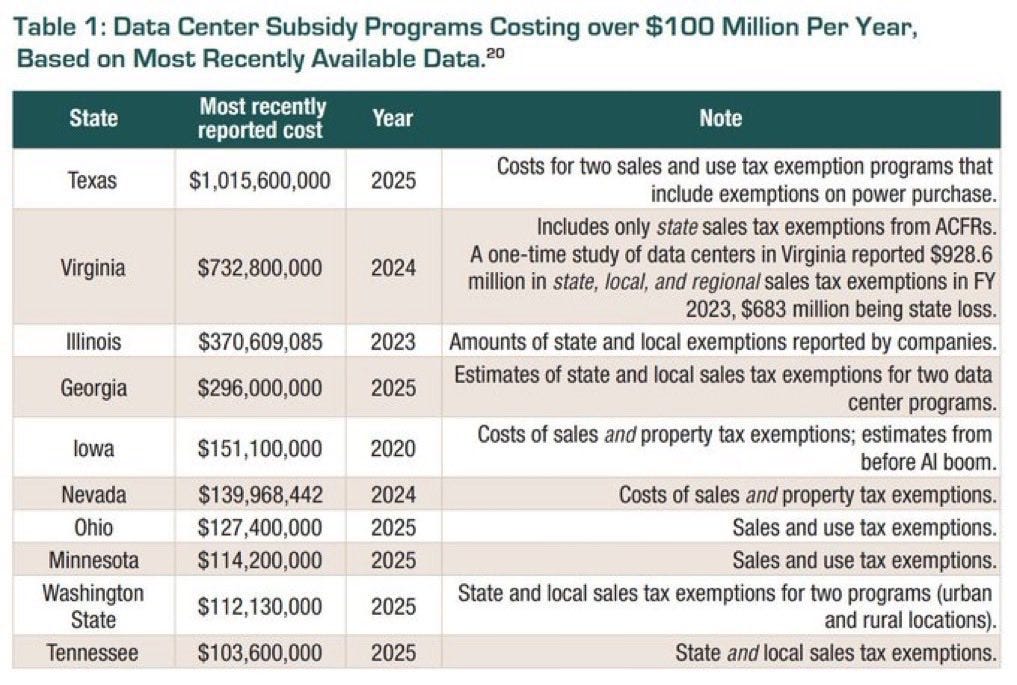
This exemption — applying the state’s 6.25% sales tax to servers, cooling systems, generators, electrical infrastructure, software, and even the electricity consumed by the facilities — is temporary (10 or 15 years depending on investment size) but expansive. Qualifying projects generally need at least $200 million in capital investment and 20 new jobs (or higher thresholds for larger facilities). Critics note these job requirements are modest for billion-dollar AI projects that consume enormous amounts of power and water but employ relatively few ongoing workers.
The program has become one of Texas’s most expensive incentive efforts, with costs rising dramatically from just $5–30 million per yearbetween 2014 and 2022 to the current billion-dollar scale. Over the 2028–2029 biennium, projections reach as high as $3.3 billion in forgone revenue.
Governor Abbott has also utilized the Texas Enterprise Fund (TEF) — a “deal-closing” grant program he oversees — for targeted performance-based incentives when Texas competes against other states for major projects. While specific TEF grants tied exclusively to data centers are not always itemized publicly (many announcements bundle them with broader tech or energy investments), the fund has historically supported high-impact economic development. Abbott has additionally highlighted related investments, such as a $350 million nuclear fund launched to help meet data center power needs.
Local governments layer on property tax abatements (via Chapter 312 agreements), further sweetening deals in counties and cities eager for investment. Combined with Texas’s no-income-tax environment and deregulated ERCOT market, these tools have helped secure commitments like Google’s massive expansion.
Incentives in the Spotlight: Rep. Ken King’s Hearing and Senate Bill 6
These subsidies were a backdrop — if not always the explicit focus — at the April 9, 2026, interim hearing of the Texas House Committee on State Affairs, chaired by Rep. Ken King (R-Canadian). The session examined the data center surge, with more than 413 active data centers already operating in the state and hundreds more planned.
Testimony highlighted ERCOT’s Large Load Queue and the transition to a new Batch Study Process for more efficient handling of interconnection requests. Under the old single-project approach, frequent “restudies” caused delays; the batch method groups projects for collective analysis every six months, aiming to provide certainty while protecting reliability. Witnesses, including ERCOT President & CEO Pablo Vegas and PUCT Chairman Thomas Gleeson, discussed Senate Bill 6 (SB 6) — the 2025 law imposing guardrails on large loads (≥75 MW). SB 6 requires financial commitments, study fees, emergency curtailment capabilities, and better forecasting to prevent cost shifts to other ratepayers and stranded transmission upgrades.
Water consumption also featured prominently. Data centers supporting dense AI workloads rely on cooling, with existing facilities already using billions of gallons annually. Projections vary widely (potentially 2–3% of state water use by 2030), prompting calls for better data on evaporative versus air-cooled or liquid systems. Developers touted efficiency gains, but community concerns about drought-prone areas persist.
Trade-Offs and the Path Forward
Supporters, including Abbott’s office, argue the incentives deliver strong returns through capital investment, construction jobs, indirect economic activity, and positioning Texas as an AI and national security leader. Data centers reportedly generated $3.2 billion in combined state and local tax revenue in 2024 (including property and other taxes), with projections of even higher future contributions.
Critics counter that the forgone sales tax revenue — now measured in billions under Abbott — could fund schools, infrastructure, or grid upgrades, especially as the queue strains ERCOT and water demands grow. Some lawmakers have signaled reviews of the sales tax exemption ahead of the 2027 session, with Senate Finance Chair Joan Huffman planning hearings on its sustainability.
Rep. King has indicated his committee will hold additional hearings, including one with public testimony, as Texas weighs how to refine incentives, enforce SB 6 guardrails via batch studies, and balance growth with reliability and resource constraints.
As the AI race intensifies globally, Governor Abbott’s incentive strategy has undeniably accelerated Texas’s rise. Whether the public return — in jobs, revenue, and resilience — matches the scale of subsidies offered will likely dominate debate in the coming months and the 2027 legislative session