
Harris County, Texas, operates one of the more extensive networks of Flock Safety automated license plate reader (ALPR) cameras in the region. Managed largely through the Harris County Sheriff’s Office (HCSO), the system captures vehicle details and feeds real-time alerts to investigators. Most cameras are not county-owned; instead, municipal utility districts, homeowners associations, precincts, and other local entities purchase them and grant HCSO administrative access.How the Network Took ShapeFlock Safety technology first appeared in the greater Houston area around 2018–2019, with early adopters including police departments in Jersey Village, Katy, and the Memorial Villages. Harris County government moved more formally later. After advertising a request for proposals in October 2022, the county signed a Master Agreement with Flock Group, Inc. on June 6, 2023, covering license plate readers and an accompanying sound-detection system. Parallel efforts occurred at the precinct and district level. Precinct 3 began supplying readers to constables in early 2023. In January 2024 the East Aldine Management District approved a five-year contract for 60 cameras. The core county contract has been renewed annually; on May 28, 2026, Commissioners Court extended it through June 5, 2027, by a 4–0 vote, with County Judge Lina Hidalgo abstaining.
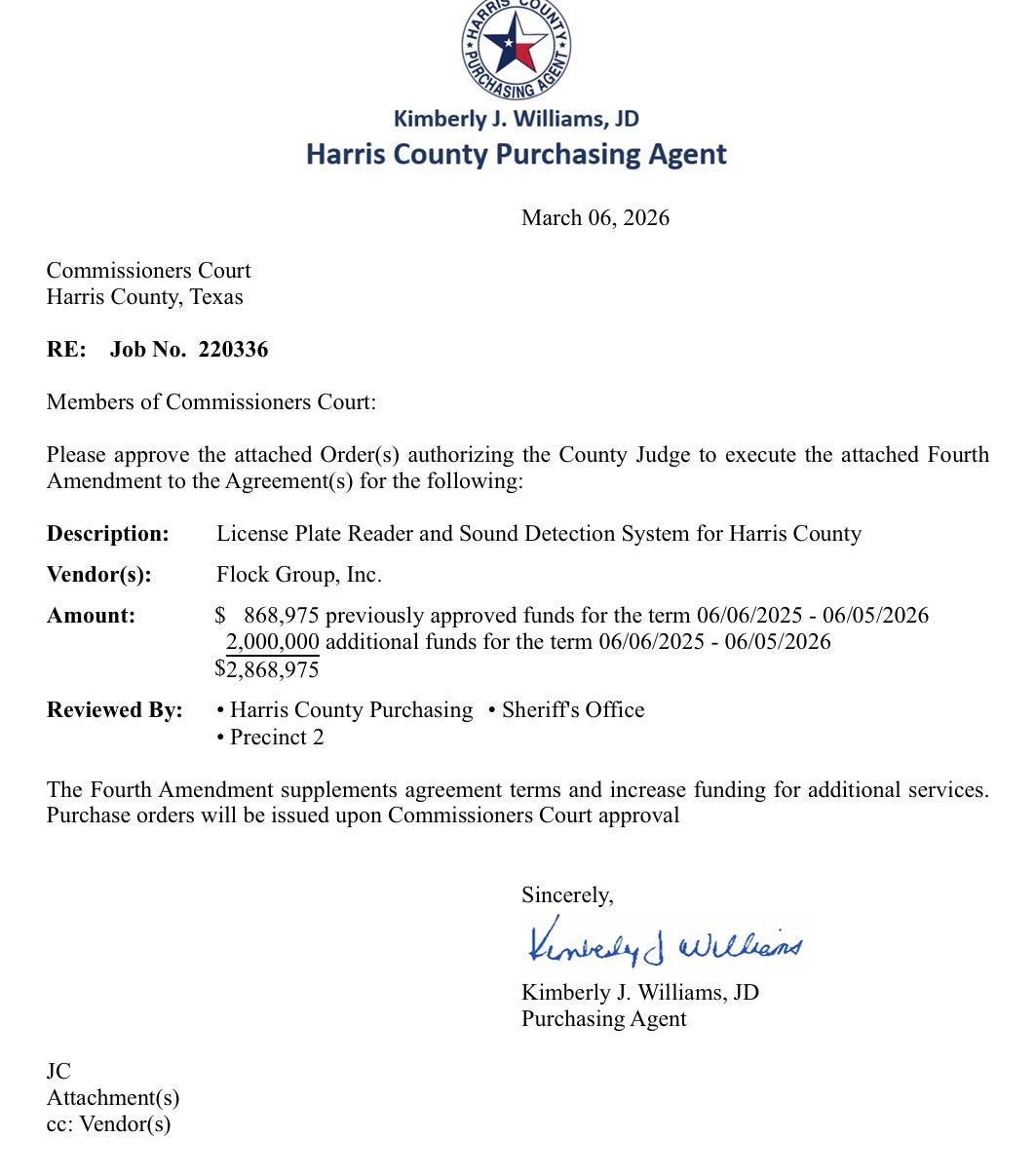
The county’s primary contract with FlOCK covering the platform, administrative access, LPR services, and sound detection has run approximately $2,869,000 per year. The most recent renewal was priced at $2,000,000. Amendments have occasionally added further funding for expanded services.Individual cameras typically cost $2,500–$3,000 annually to operate. Because the majority are bought by MUDs, HOAs, and precincts rather than the county itself, taxpayer exposure through the central contract remains limited relative to the size of the network. East Aldine’s package of 60 cameras, for example, was budgeted at roughly $939,000 over five years.Scale of Deployment By May 2026 HCSO reported access to about 480 Flock ALPRs, with contemporaneous accounts describing a network approaching 500 devices across subdivisions, commercial areas, and unincorporated parts of the county. The wider Houston metro area contains several thousand more cameras operated by the Houston Police Department and private parties.
Why Officials Say the Cameras Are Needed
HCSO and supporting commissioners describe the system as an investigative tool. Cameras automatically flag plates associated with stolen vehicles, homicides, kidnappings, and other serious crimes, as well as vehicles linked to AMBER or Silver Alerts. They record license plate numbers, vehicle make, model, color, body type, and location/time stamps from rear-facing images. Officials emphasize that the technology does not employ facial recognition or biometric data. A paired sound-detection component is designed to identify gunshots, screeching tires, and breaking glass. Law-enforcement leaders have called the network “another set of eyes,” citing concrete cases in which alerts helped recover stolen vehicles, locate kidnapped children, and identify suspect cars in fatal hit-and-run crashes. Data is retained for a limited period (commonly 30 days), owned by the participating agencies, and accessible only for criminal investigations, with access logged.Crime Trends After DeploymentNo official analysis isolates the Flock network as the sole cause of changes in county crime rates. Still, HCSO figures show declines between 2023 and 2024—the first full year after the county contract took effect:
Homicides fell from 115 to 96.
Robberies dropped roughly 17 percent (1,597 to 1,312).
Aggravated assaults declined nearly 12 percent (2,820 to 2,490).
Vehicle thefts fell about 15 percent.
These movements tracked national post-pandemic reductions in violent and property crime. Local initiatives, including specialized units in high-crime pockets such as Cypress Station, also contributed. Houston Police Department officials, operating a larger and earlier network, have credited Flock systems with assisting in the recovery of more than $7.4 million in stolen vehicles and supporting daily investigations. Independent observers note that national trends account for a substantial share of the observed declines.
Supporters point to investigative successes and the practical challenges of policing a large unincorporated population. Critics, including residents who spoke against the 2026 renewal and civil-liberties groups, argue that continuous collection of data on everyday drivers raises privacy risks, creates potential for misuse, and lacks sufficient transparency. Concerns have also been voiced about possible sharing with outside agencies, including for immigration enforcement. County and Flock representatives respond that access is restricted to specific criminal investigations and that Flock maintains no direct contract with ICE. The May 2026 contract extension proceeded amid public comment and procedural friction on Commissioners Court. Officials left open the possibility of future amendments addressing privacy safeguards. Harris County’s Flock network reflects a hybrid model—locally funded cameras feeding a shared law-enforcement platform. It has demonstrably aided individual investigations and coincides with measurable drops in several crime categories. Whether those drops would have occurred at the same scale without the technology, and how the privacy costs should be weighed, remain subjects of active local debate as the system continues under its latest one-year authorization.