
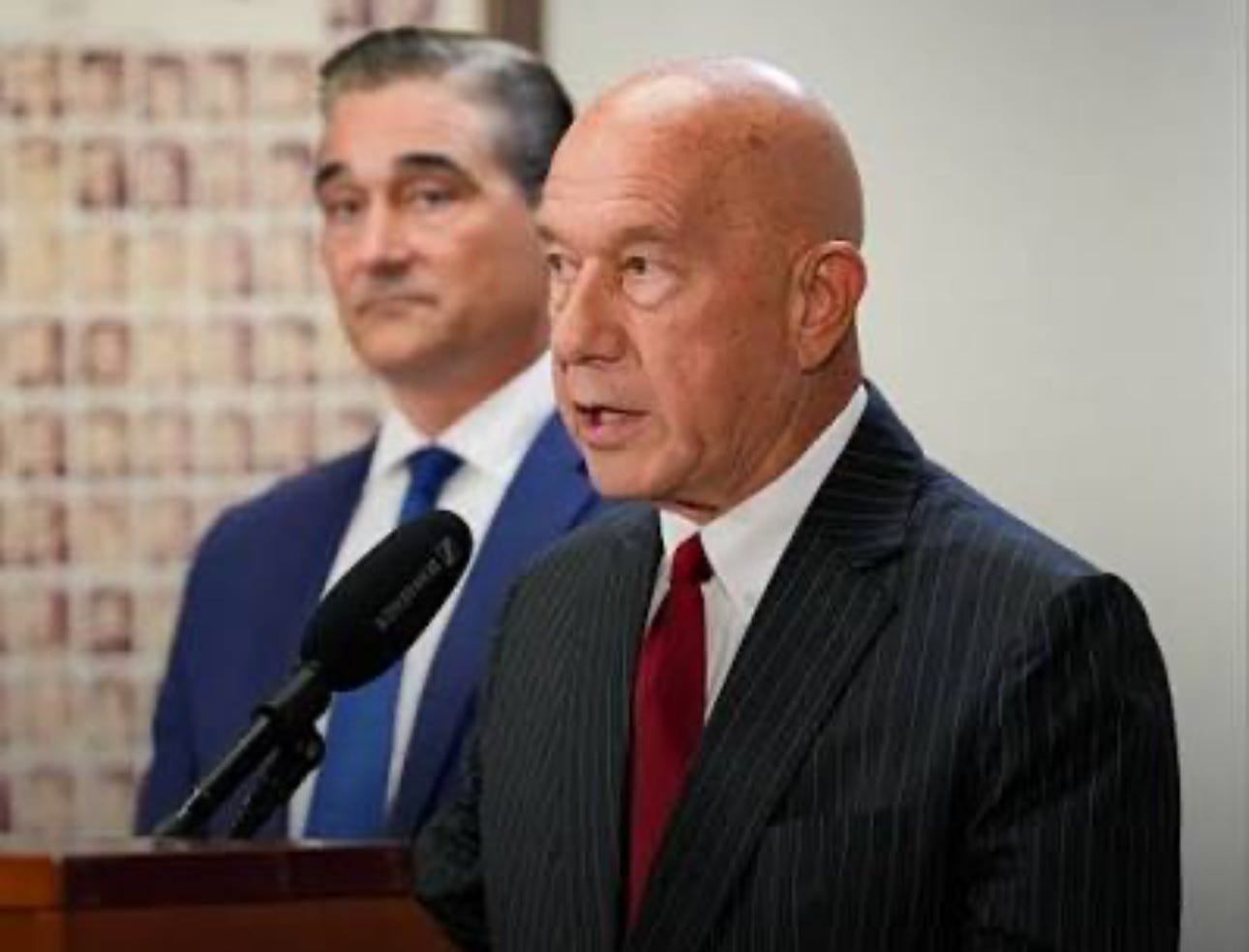
Houston City Council passed an ordinance on April 8, 2026, by a 12-5 vote that restricts the Houston Police Department’s cooperation with U.S. Immigration and Customs Enforcement.
The measure, led by Council Member Alejandra Salinas along with Council Members Abbie Kamin and Edward Pollard, prohibits HPD officers from detaining individuals or extending traffic stops solely based on civil immigration warrants (ICE detainers). It also removes a previous requirement for officers to wait 30 minutes for ICE agents to arrive and requires the mayor’s administration to provide regular reports on the department’s interactions with federal immigration authorities.
Supporters, including Salinas, argued the ordinance allows local police to focus on criminal activity and maintain community trust, while still complying with all mandatory state and federal requirements for reporting certain criminal matters. The proposal was placed on the agenda using authority granted by Proposition A, a 2023 charter amendment. Mayor John Whitmire initially expressed support for the measure as a way to show the city is responsive to community concerns, though a stronger version of the ordinance was scaled back after the City Attorney raised concerns about potential conflicts with state law.
The ordinance drew an immediate and sharp response from state officials. Governor Greg Abbott’s Public Safety Office notified Mayor Whitmire in writing that the new policy (Section 34-41 of the Houston Code of Ordinances) violates the city’s certifications and agreements for state funding. The governor’s office threatened to withhold approximately $110 million in public safety grants for Fiscal Year 2026, which fund the Houston Police and Fire Departments, emergency services, and preparations for major events including the 2026 FIFA World Cup. The city was given until April 20, 2026, to confirm it will not enforce the ordinance and will repeal it, or risk losing the funding and facing demands for repayment.
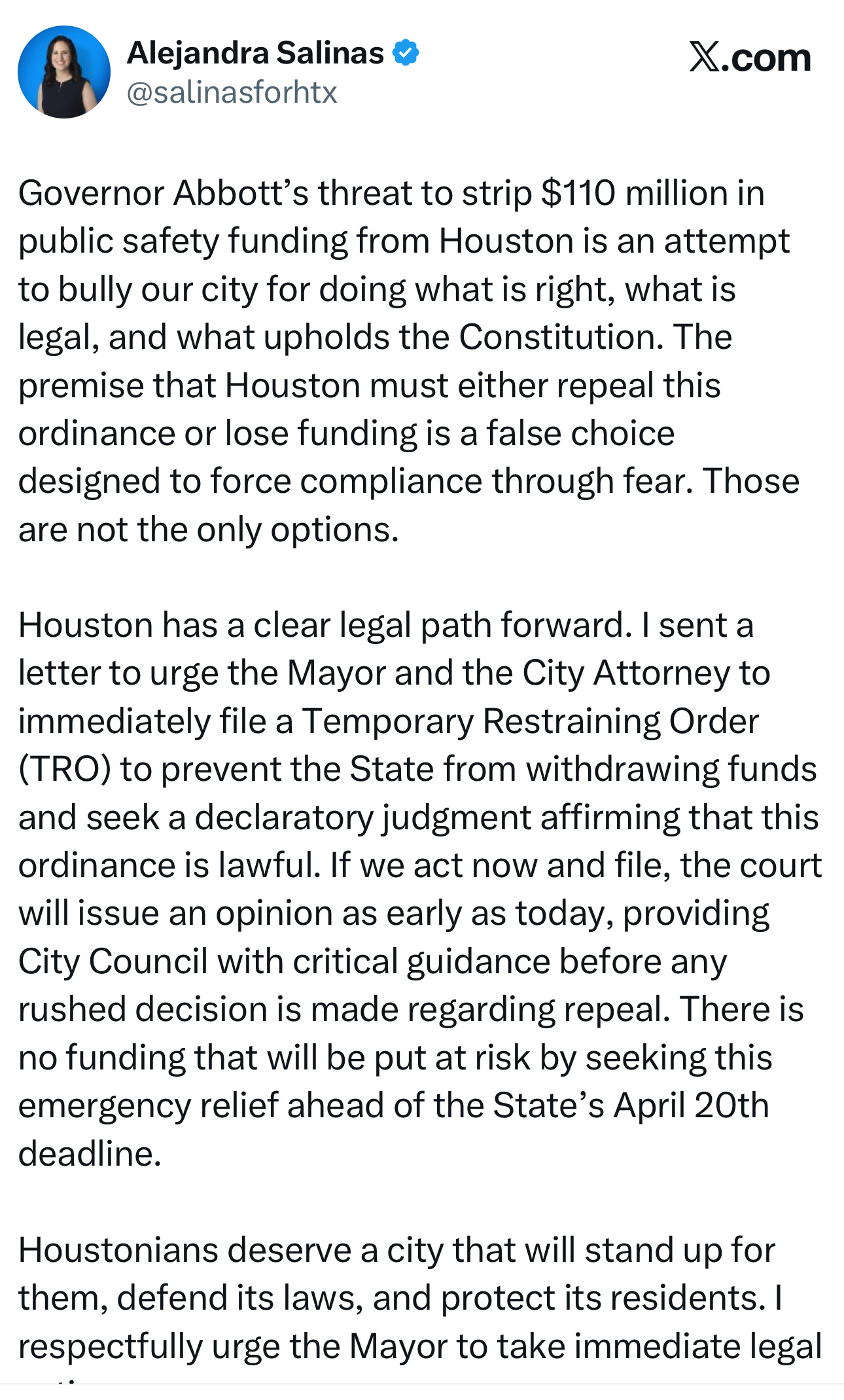
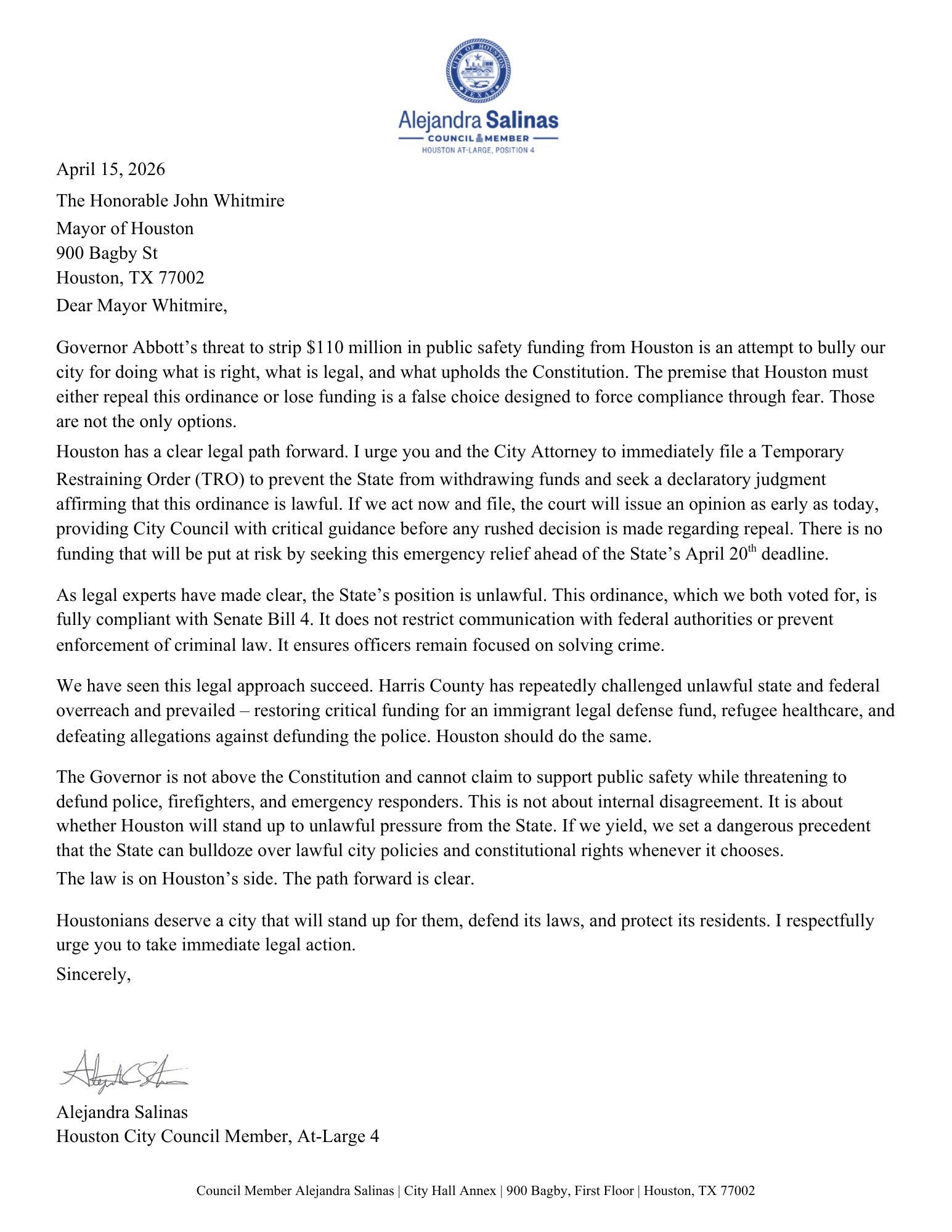
In a letter dated April 15, 2026, Council Member Salinas urged Mayor Whitmire and the City Attorney to mount an immediate legal challenge. She described the governor’s threat as “an attempt to bully our city for doing what is right, what is legal, and what upholds the Constitution.” Salinas maintained that the ordinance complies with Texas law, does not prevent communication with federal authorities, and does not interfere with criminal law enforcement. She recommended filing a Temporary Restraining Order (TRO) and seeking a declaratory judgment to affirm the ordinance’s legality, noting that courts could act quickly without placing funding at immediate risk.
Salinas also issued a public statement calling the governor’s action “straight out of the schoolyard bully playbook.” She argued that Abbott is “wrong on the law” and that the ordinance is protected by constitutional principles, including protections under the Fourth Amendment. She criticized the move as putting politics ahead of public safety and pledged to work with the mayor and council to defend the city’s position.
The conflict centers on Texas Senate Bill 4 (SB 4), the 2017 anti-sanctuary city law signed by Governor Abbott. The law, codified in Texas Government Code Chapter 752, Subchapter C, prohibits local governments and police departments from adopting policies that “prohibit or materially limit” the enforcement of federal or state immigration laws. It remains in effect after being largely upheld by the Fifth Circuit. Violations can result in significant civil penalties, criminal charges against officials, and potential removal from office.
In response to the funding threat, Mayor John Whitmire has scheduled a special City Council session for April 17, 2026, to discuss whether to repeal or modify the ordinance. The meeting will weigh the serious financial risks to police, fire, and emergency services against the legal and policy arguments for limiting cooperation with ICE on civil immigration matters.
The dispute reflects ongoing tensions between Texas’s strict statewide immigration enforcement requirements and efforts by major cities like Houston to limit local involvement in non-criminal federal immigration actions. As of April 15, 2026, the city has not made a final decision.