
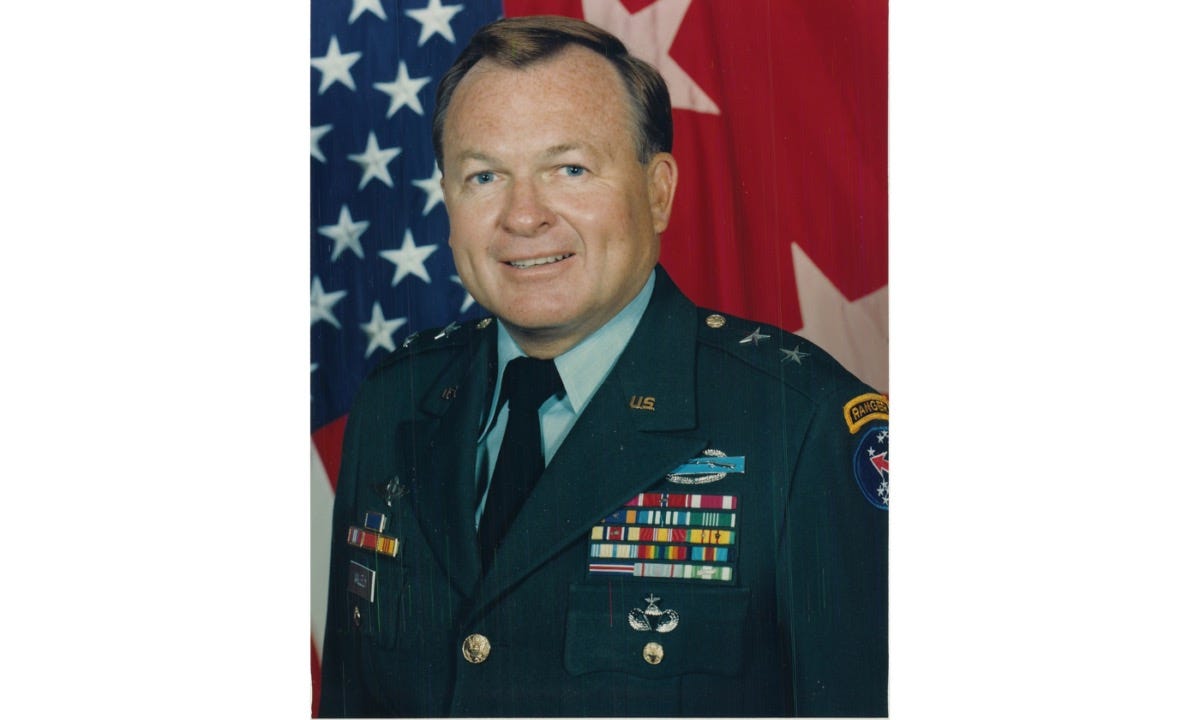
Retired U.S. Army Major General Paul E. Vallely (sometimes rendered as “Valley” in older documents) built a career centered on psychological operations and information warfare. In 1980, while commanding the 7th Psychological Operations Group, he coauthored a concept paper titled From PSYOP to MindWar: The Psychology of Victory with Major Michael A. Aquino, a PSYOP research and analysis team leader under his command.
That document has since become a touchstone in discussions of modern influence operations, narrative control, and more controversially allegations of systematic psychological manipulation. Vallely later joined the advisory council of Turning Point USA (TPUSA), the youth focused conservative organization founded by Charlie Kirk. These threads military psyops doctrine, an occultist coauthor, and a prominent role advising a high profile political youth movement form a documented chain that raises legitimate questions about the evolution of influence techniques in American public life.
Vallely’s Military Background and PSYOP Expertise
Paul E. Vallely graduated from West Point in 1961. He served two combat tours in Vietnam as an infantry company commander, intelligence officer, and adviser. His later career emphasized psychological and civil affairs operations. He commanded the 7th PSYOP Group (headquartered at the Presidio of San Francisco) around 1980 and later the 351st Civil Affairs Command, which oversaw Special Forces, psychological warfare, and civil military units across the western United States and Hawaii. He retired in 1991 as Deputy Commanding General, U.S. Army Pacific, at the rank of major general.
Vallely’s post retirement work included serving as a Fox News military analyst after 9/11, coauthoring Endgame: The Blueprint for Victory in the War on Terror (2004) with Lt. Gen. Thomas McInerney, founding Stand Up America US (a conservative national security group), and engaging in counter jihad and veterans’ advocacy circles. He has also been publicly associated with QAnon related commentary, describing it at times as a “white hat” military intelligence operation.
The 1980 MindWar Paper: From Traditional PSYOP to Strategic Mind Influence
The paper From PSYOP to MindWar (full title in the original: From PSYOP to MindWar: The Psychology of Victory) was an internal U.S. Army concept paper, not a formal doctrine publication. Vallely, as commander, tasked Aquino with drafting it to stimulate new thinking after the perceived failures of Vietnam era PSYOP.
Core thesis: Traditional PSYOP leaflets, loudspeakers, tactical battlefield messaging was reactive, limited, and ultimately ineffective. The United States had been “out PSYOPed” in Vietnam, losing the war not primarily on the battlefield but in the minds of both enemy populations and the American public. The authors argued that future conflicts would be decided by control of perception, belief, and will.
MindWar definition (direct quote): “the deliberate, aggressive convincing of all participants in a war that we will win that war.”
Key distinctions and proposals:
• Strategic priority: Psychological operations should precede and shape military decisions rather than serve as a “force multiplier” after the fact.
• Scope: Target all participants enemies, allies, neutrals, and domestic U.S. populations to strengthen American resolve while weakening the enemy’s will before combat begins.
• Methods: Overwhelm with argument and conviction; seize control of information environments (television, radio, emerging satellite and electronic media); use timing with environmental factors (atmospheric conditions, electromagnetic effects) to enhance receptivity; establish “rapport” for subconscious influence while insisting on speaking what the authors framed as “truth” with personal commitment
• Non lethal ideal: Conduct warfare through perception dominance to reduce physical destruction, though the paper acknowledges harsh realities of conflict. • Domestic dimension: Explicitly discusses strengthening U.S. national will and countering enemy propaganda at home, while noting legal constraints on direct PSYOP targeting of American citizens
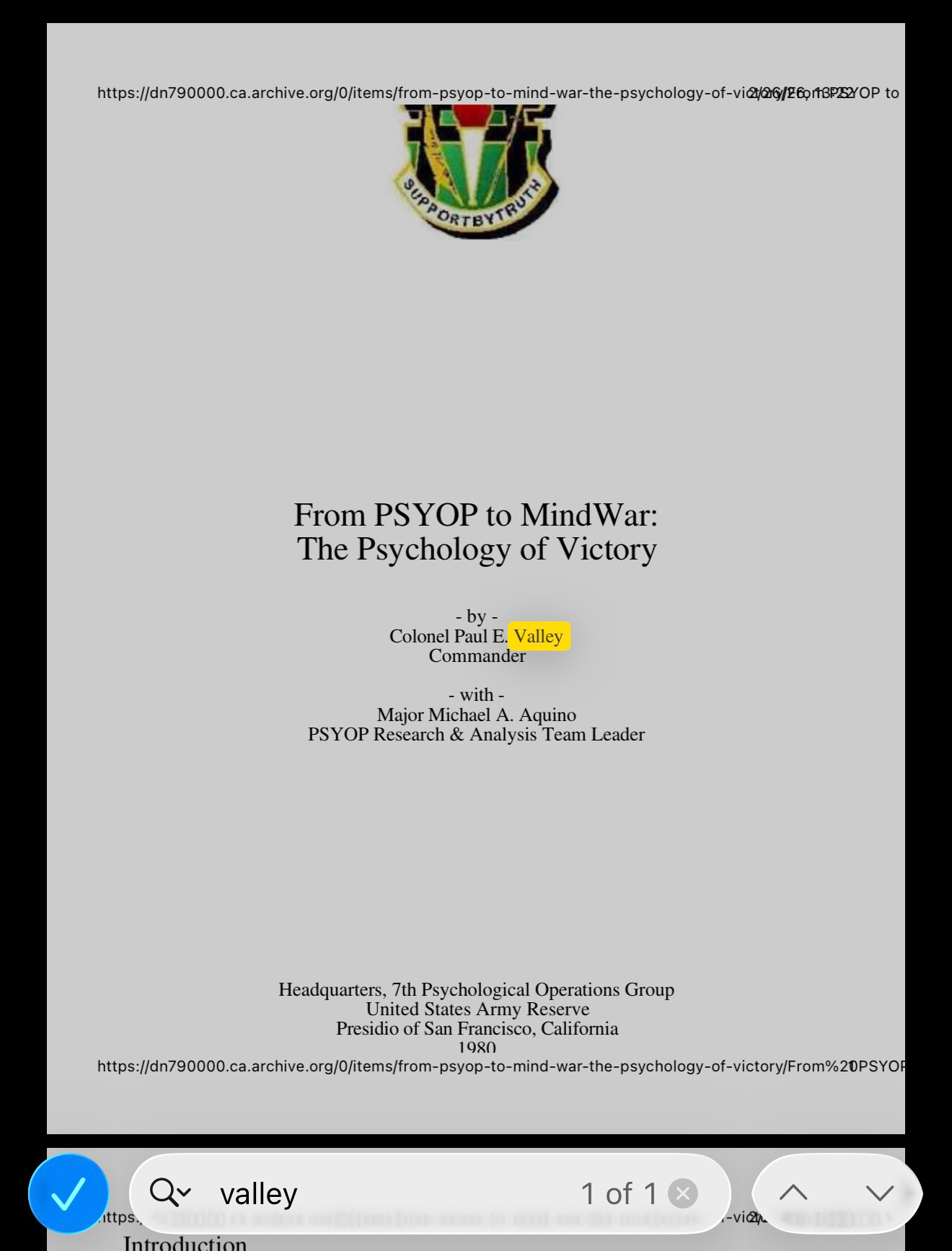
The paper envisions “MindWar teams” embedded at every level of command and critiques the military industrial complex for resisting approaches that might reduce demand for conventional weapons. A 2003 introduction by Aquino (then retired) noted that the paper had become a frequent subject of conspiracy theories.
Aquino later expanded the ideas in his own writings, including the 2013 book MindWar.
Michael Aquino: Soldier, Occultist, and Co Author
Michael A. Aquino (1946–2019) was a U.S. Army psychological warfare and intelligence officer. He served in Vietnam (including with Green Berets elements), held NATO liaison and attaché roles, and worked in PSYOP research. He retired honorably as a lieutenant colonel.
In 1975, Aquino founded the Temple of Set after breaking with Anton LaVey’s Church of Satan. The Temple of Set is a self described occult organization centered on the Egyptian deity Set (often equated by outsiders with Satan or adversarial forces), emphasizing self deification, individualism, and “Black Magic” as a path to personal power. Aquino produced extensive writings on both military psychological operations and Setian philosophy.
The Presidio controversy (1986–1987): During the height of the “Satanic Panic,” Aquino was investigated in connection with alleged child sexual abuse and ritual abuse at the Presidio Child Development Center in San Francisco. A child identified him; the investigation was closed for insufficient evidence (Aquino and his wife had a documented alibi in Washington, D.C.). No charges were filed. Aquino sued authors of books implying his guilt; those cases settled out of court. The episode remains divisive some view it as part of a broader cover up of ritual abuse networks, while others see it as a classic example of Satanic Panic overreach.
Aquino’s dual identity Army PSYOP specialist and founder/high priest of an explicitly occult organization has fueled decades of speculation linking military mind influence doctrine with darker claims of trauma based programming, cults, and elite networks.
“Mind Control” Context: Strategic Influence vs. Individual Programming
The term “mind control” in popular discourse often evokes MKUltra style programs (documented CIA experiments involving drugs, hypnosis, sensory deprivation, and trauma on unwitting subjects). The Vallely Aquino paper does not describe those techniques. It outlines strategic psychological operations aimed at populations: shaping beliefs, morale, and perceived inevitability of victory through media dominance, narrative framing, environmental timing, and conviction based messaging.
Critics in conspiracy research communities argue that: Aquino’s occult background plus the paper’s emphasis on subconscious rapport, environmental influence factors, and total information environment control points to a bridge between military doctrine and ritual/mind programming practices. The Presidio allegations and Temple of Set philosophy suggest possible overlap with claims of satanic ritual abuse (SRA) and trauma based mind control. Later expansions by Aquino and the paper’s vision of global media penetration prefigure modern information warfare, social media psyops, and narrative control operations.
Defenders note that the paper was a forward looking concept from Cold War officers seeking to avoid another Vietnam style information defeat, that Vallely himself has no documented occult affiliations, and that “MindWar” remains largely theoretical rather than proven operational doctrine.
The document is publicly available and has been discussed in military, academic, and online circles for decades. Its influence appears more philosophical than prescriptive in Vallely’s later public work.
Vallely’s Role with Turning Point USA
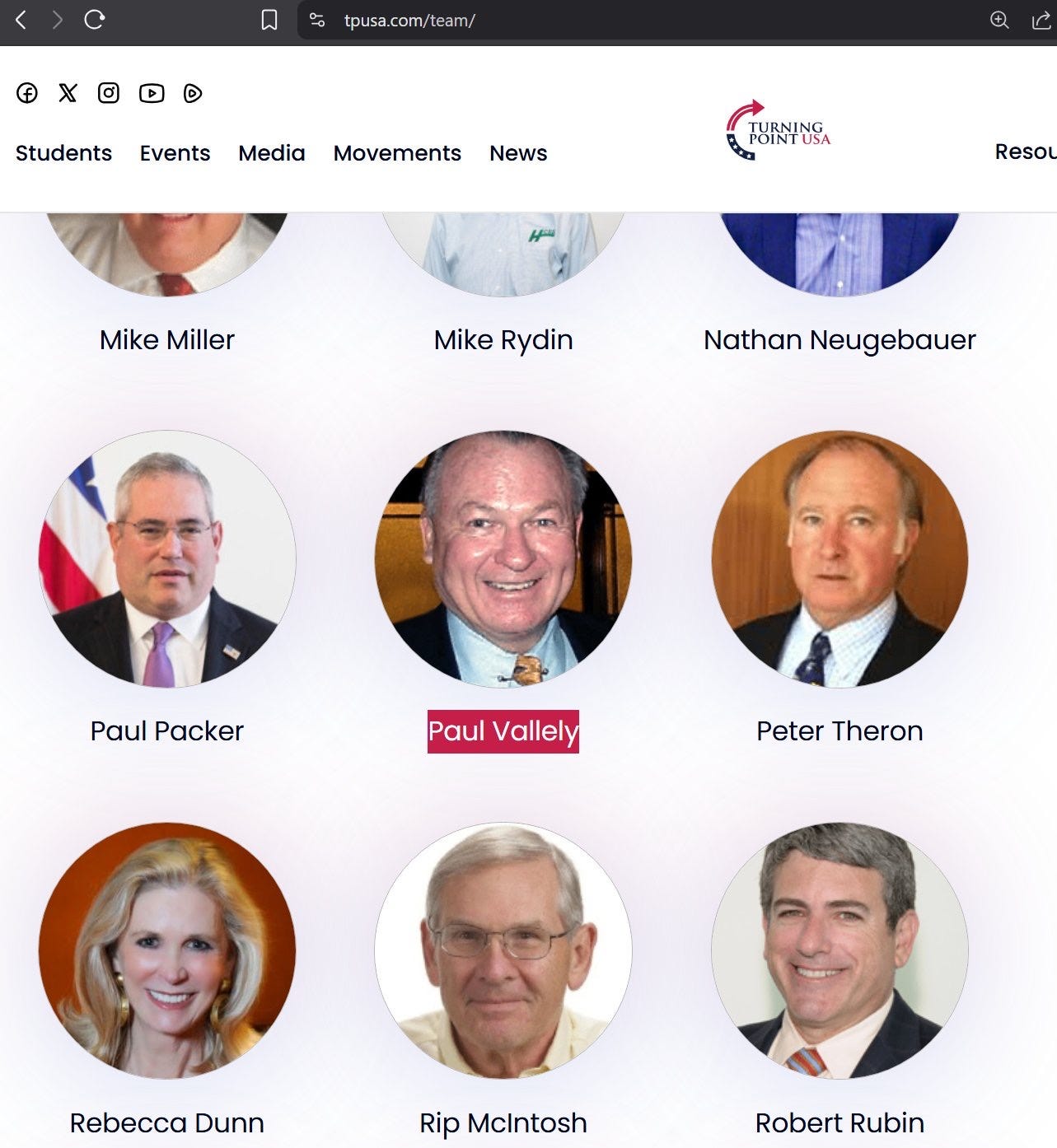
At one point Vallely served on the Advisory board for TPUSA, which positions itself as a defender of conservative principles limited government, free markets, patriotism, and traditional values targeting high school and college students through campus chapters, large scale events, social media, and influencer networks. Its rapid growth and polished messaging have made it one of the most visible youth political organizations on the right.
The presence of a retired PSYOP general whose most cited work was coauthored with the founder of the Temple of Set on its advisory council has prompted scrutiny in Christian, conservative, and independent research communities.
Q’s:
• Given Vallely’s extensive PSYOP expertise and the MindWar emphasis on shaping perceptions and wills across entire populations, could TPUSA’s slick, high production events and campus tactics represent applied psychological operations designed to influence young minds at scale?
• Does the rapid narrative synchronization, emotional mobilization of youth, and coordinated influencer responses within TPUSA echo the strategic information environment control and subconscious rapport techniques outlined in the Vallely Aquino paper?
• If a key advisor with deep military psychological warfare background helps guide a major youth conservative organization, how do we know whether their methods prioritize genuine faith and values or sophisticated mind influence and perception management?
• Are patterns of polished branding, swift handling of dissent, and mass youth engagement in TPUSA consistent with modern domestic applications of MindWar style doctrine targeting American populations?
• Could the occult ties in the paper’s origins combined with TPUSA’s prominent role in forming the next generation suggest hidden layers of psychological warfare being deployed under the banner of traditional conservatism?
• What accountability exists when organizations invoking moral clarity and Christianity receive advisory input from architects of PSYOP and MindWar strategies?
There is no public evidence that TPUSA has formally adopted the 1980 MindWar paper as operational doctrine. Vallely’s advisory contributions appear to draw on his national security, media analysis, and conservative activism experience. However, the documented association exists and invites examination of influence networks within modern political movements.
Implications and the Need for Discernment
The Vallely Aquino collaboration and Vallely’s subsequent advisory role with TPUSA illustrate a recurring pattern: individuals with deep experience in psychological influence and information operations migrating into civilian political, media, and youth education spaces. In an age of algorithmic social media, AI generated content, and polarized information ecosystems, concepts once discussed in military concept papers now operate at scale in the open.
For those concerned with truth, spiritual integrity, and the protection of vulnerable populations (especially youth), several principles remain relevant: • Test the fruit, not just the branding. Large organizations and polished messaging can mask underlying methodologies. • Examine networks and histories. Associations with architects of psychological doctrine whether framed as legitimate national security tools or otherwise warrant transparency and scrutiny. Guard the mind. Whether through ancient wisdom traditions or modern psychological insight, the battle over perception and will is real. Techniques that bypass conscious reasoning or exploit emotional and environmental vulnerabilities deserve rigorous evaluation. •Reject both naivety and paranoia. Not every connection implies a grand conspiracy; not every denial erases documented history.
Paul Vallely’s career reflects a professional military focus on winning conflicts in the domain of the mind. Michael Aquino brought both PSYOP expertise and an explicit occult framework to the same conversation. Their 1980 paper remains a primary source for understanding one trajectory of American psychological operations thinking. Vallely’s later presence in conservative youth activism through TPUSA places that history in a contemporary context.
Sunlight on these connections does not equate to guilt by association. It does, however, serve the public interest in understanding how influence is conceptualized, who conceptualizes it, and where those ideas surface in the formation of the next generation’s political and cultural worldview.
Primary sources for further reading: • The full 1980 paper From PSYOP to MindWar (available via public archives such as DocumentCloud and Archive.org). • Wikipedia entries and biographical materials on Paul E. Vallely and Michael A. Aquino (cross referenced with primary military records). • TPUSA’s public advisory council listings and event materials.
Discernment remains the responsibility of the reader. In matters of mind, will, and the shaping of young consciences, clarity is not optional.