
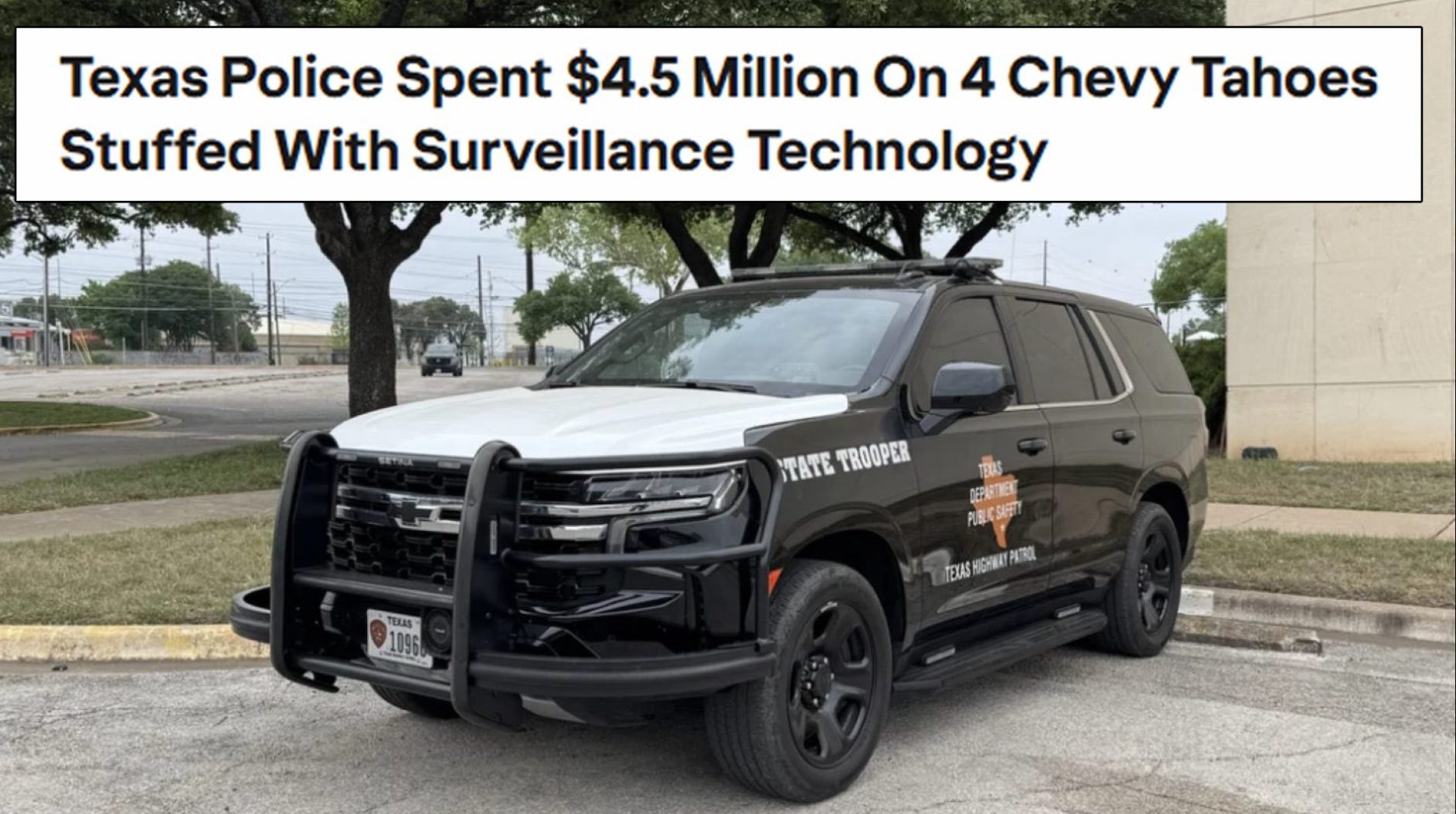
In March 2026, the Texas Department of Public Safety’s Criminal Investigations Division approved an emergency purchase totaling $4,487,500 for four specially outfitted 2026 Chevrolet Tahoes. Roughly $600,000 covered the vehicles themselves. The bulk of the spending—about $3.9 million—went to Israeli company Cognyte for FalcoNet cellular surveillance systems and related equipment.An internal emergency decision memo dated March 4, 2026, justified the expedited process by citing the need “to protect the safety and welfare of state personnel and property.” Officials warned that delays would create “unacceptable safety risks” and undermine “operational readiness” and “mission success.” The document referenced potential applications such as locating missing persons, supporting manhunts, tracking suspects, and improving officer awareness, but provided no concrete threat or incident that necessitated bypassing normal competitive bidding and public review. Cost Breakdown Documents show the major line items included:
Four FalcoNet core systems: $2.85 million
5G software licenses: $280,000
Portable backpack units supporting multiple cellular generations
Antenna kits and additional hardware
Four police-pursuit Tahoes: $600,000 ($150,000 each)
The vehicles are otherwise standard law-enforcement models. The surveillance gear is designed to be discreet, with antennas that can be concealed or disguised so the SUVs blend in with ordinary traffic.Capabilities of the TechnologyFalcoNet functions as a cell-site simulator. It impersonates a legitimate cell tower, prompting nearby phones to connect automatically. Once connected, the system can capture device identifiers and obtain real-time location data across 2G, 3G, 4G, and 5G networks. The equipment can operate from the Tahoes, be carried in backpacks for mobile foot operations, or potentially be mounted on aircraft. It collects information from devices in range regardless of whether the owners are targets of an investigation. Cognyte, spun out of Verint, markets the platform for law-enforcement and intelligence use. Comparable systems have been acquired by agencies in other states. Questions of Oversight and Constitutional Limits Public information remains sparse. The emergency designation limited advance transparency, and released records have often been heavily redacted. DPS has not publicly released detailed policies on data retention, sharing protocols, audit requirements, or the precise circumstances under which a judicial warrant is required. U.S. Supreme Court rulings, including Carpenter v. United States, establish that detailed tracking of a person’s movements via location data generally constitutes a Fourth Amendment search that requires a warrant, though exceptions exist for true emergencies. Texas currently has no comprehensive state statute specifically regulating cell-site simulators or mandating warrants and reporting for their use. The acquisition has drawn scrutiny amid rising property-tax pressures and the broader expansion of surveillance tools across Texas, including widespread automated license-plate reader networks. While proponents highlight potential benefits for time-sensitive investigations and officer safety, the combination of significant cost, vague emergency justification, and powerful data-collection capability has prompted calls for clearer rules on oversight, data handling, and constitutional protections. Greater public disclosure from the Department of Public Safety regarding both the specific justification for the emergency purchase and the ongoing operational safeguards would help address outstanding questions about how these systems are governed.